
How to Find a Great Tailor
Finding a great tailor can completely change the way you shop—and the way you feel in your clothes.
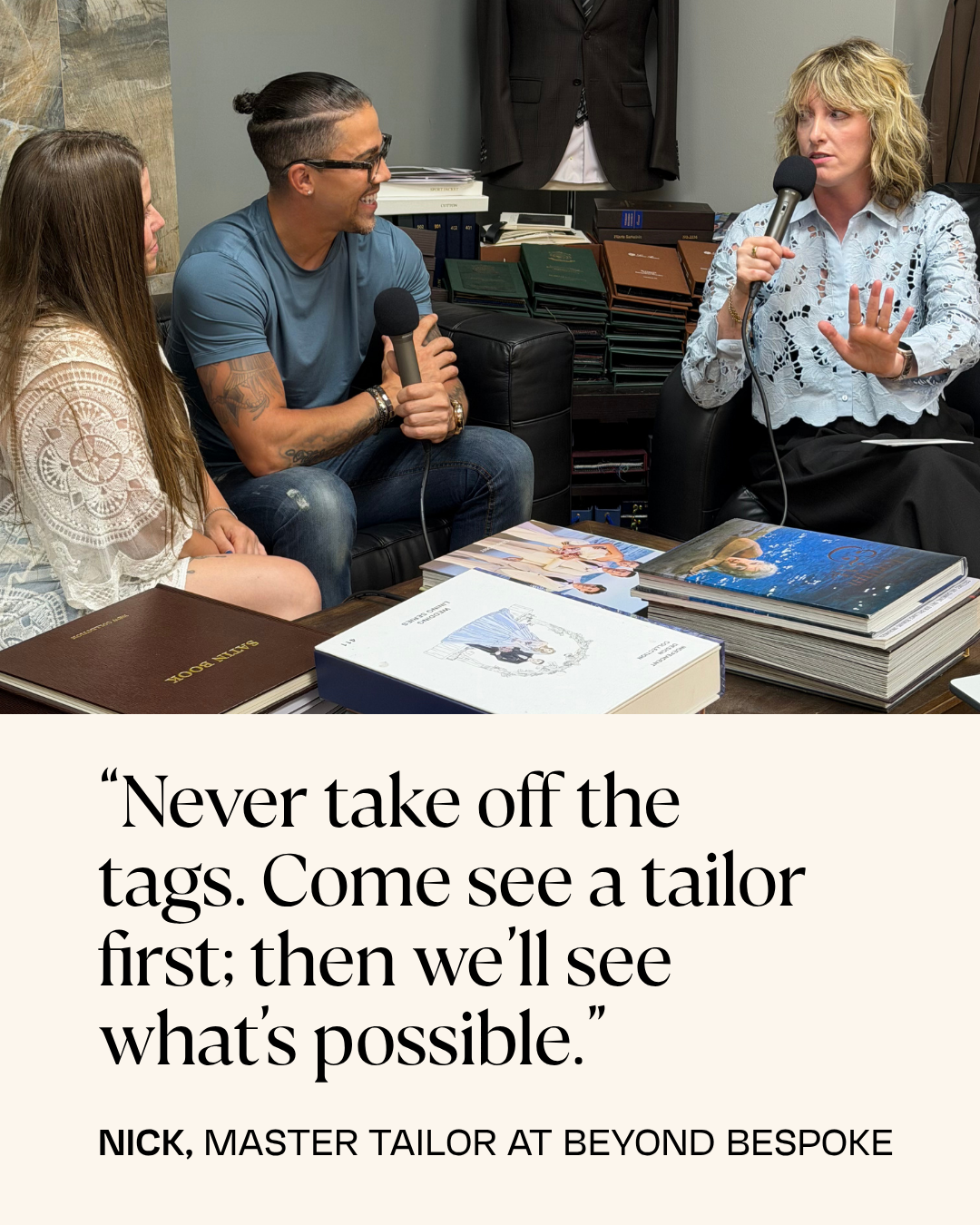
In this episode, Natalie is joined by two of her trusted style friends, Nick, a third-generation tailor and founder of Beyond Bespoke, and Stacie, who oversees client experience and operations. Together, this duo, who has been working together for 15+ years, pulls back the curtain on the world of tailoring, from the difference between a dry cleaner's alterations and custom tailoring to what to look for when searching for someone you can truly trust.
You'll also learn what terms like bespoke, made-to-measure, and custom actually mean, why tailoring is worth the investment, and how finding the right tailor can help you buy better, buy less, and wear your clothes longer.
Nick and Stacie will be back throughout the season to answer more of your tailoring questions, so consider this your introduction to two of Natalie's favorite experts.
Episode Notes & Resources:
Follow Beyond Bespoke on Instagram for tailoring tips or visit their website to schedule an appointment. Mention this podcast to get 10% off at Beyond Bespoke
Submit style questions you’d like answered in a future Wear Who You Are episode
Join BU Style Circle online membership for more of Natalie’s style resources, live Q&As, and more. Use code BUCIRCLE for one month off your subscription.
Read the full & Raw Episode transcript:
[00:00]
Nat: Hello, Wear Who You Are listeners! Today I am so thrilled to introduce you to style experts, my Style Friends, that have become a very integral part of my styling client process and who actually make a lot of magic in my closet. I'm here with Nick and Stacie of Beyond Bespoke, a third-generation tailor shop in Midtown Manhattan. I only come to Midtown for two reasons, and it's Beyond Bespoke and Broadway, so I stick with the Bs. We've known each other now for more than a decade.
A dozen years, I think we realized. So we met about a dozen years ago through a client of mine who actually found them when they were in a little small shop, and they have made Tony Award magic for her. And ever since then, they're basically part of the BU family. Like, all of our clients come. Allison, my stylist on the team, was just here with a client. So I love Nick and Stacie. They're two of the best people, truly, in the entire world. We are family now.
So today we are gonna talk about tailoring in general. We're gonna talk about how to find a good tailor. So let's dive right in. You ready? All right.
[02:03]
Nick: Absolutely. Right. The first thing I could think of—a really good tailor is if they work with shoulders. A lot of inexperienced tailors do not know how to work with shoulders, so that's normally, like, the first question I would try to ask. Dealing with anything with the front chest, which is usually where the canvas of the jacket is, shortening sleeves from the shoulder, any kind of shoulder work. If a tailor automatically shows you that they're a little—
Nat: Not sure. Hesitant.
Nick: Hesitant, exactly. Walk out the door. You know, they might not be the right person for you.
Nat: I mean, I think something that I realize is a lot of times I'll meet clients and they've never worked with a tailor before. And so I was surprised by that, but it kind of feels like it's a little bit of a lost art. Do you agree? Why do you think that is?
[02:55]
Nick: I mean, even hiring a tailor is a little bit difficult. I feel like, honestly, in the States everyone's learning to become a designer, but no one's really showing the fundamentals of how to create a paper pattern, which creates the garment that you're working with.
Stacie: I agree. I also think that even the bigger schools now are just training to be pattern makers or fashion designers, not really the man behind the fashion.
Nat: The art of the construction, it feels like. They're like, "Let me drape this and someone will figure it out." Who's that someone? Not a lot of people anymore, it feels like.
[03:33]
Stacie: Skills on sewing machines or even fittings. Nobody knows how to do—
Nat: Yes.
Nick: We just—we get a lot of people from FIT that come in all the time, and literally they don't really know what they're doing.
Stacie: And they only wanna know pattern making. "Can you show me pattern making? I want—"
Nat: Interesting. It's interesting because I will—you know, a client will say, "Can this be done? Can this be done? Can this be done?" And I always say, "I don't know," because there's so much more to tailoring a garment than just—it may not be as straightforward as it seems, right? Some things seem very straightforward to the eye, but they're not necessarily. And I feel like it's like you actually know the insides, we'll call it, of the garment.
[04:18]
Nick: I mean, one hundred percent. I mean, every garment has a different type of design specialty, and it's honestly just looking at the construction and figuring out a solution for it. You know, some garments we work with are not your basic alterations. It's honestly coming together and coming up with a solution. And that's why I've been blessed with such a great team because, you know, I may not have all the answers, but working so closely with all my guys, everyone specializes in—
Nat: You can put your heads together. You have a little, like, tailoring think tank back there.
Nick: A little meeting together.
Nat: Cool. So speaking of that, can you tell me? I know this is something you're passionate about, and I've had issues, quite frankly, with clients who say, "I'm just gonna take this to the dry cleaner on the corner." So it looks like there's a lot of tailors around. Okay. It says, like, tailor, tailor, tailor on every corner, but there's a difference between maybe your dry cleaner tailor on the corner and a custom tailor, as you call yourselves. Could you dissect that?
[05:18]
Nick: Absolutely. I feel like, you know, if you own a machine and know how to work it, you could make yourself—you're a tailor. I think the difference between that type of tailor and what we do is we can construct a garment from scratch. Can they do the same? You know, it really comes down to that. And it all comes with experience, you know. So when I was nineteen, I thought I was the best. I knew it all, but little did I know, as I worked with different tailors along the way, I learned something new, and I kept on learning, kept on learning. Now, twenty years later, I feel like I'm the best now. But you know what? You're always learning. In this business, there's always a new pattern. There's always a new designer. There's always something new. And that's what's so great about being in the fashion industry. You're just always learning, and it's really exciting to be in it.
[06:13]
Nat: I can completely relate to that. When I started styling, I'm like, "Well, I learned everything. These are all of the ABCs of styling, and I know it all." And then you learn—you learn how to read people more too, I feel like is part of—
Nick: One hundred percent. And it's also—I'm sorry, go ahead.
Stacie: Well, one of the things that makes a custom tailor better than a regular tailor, I feel like if you go into a dry cleaner and they're just gonna hem your pants and shorten your sleeves, they're not looking at your body at all. They're just looking at what doesn't fit you.
Nat: That's a good point.
Stacie: So Nick is an artist. He—
Nat: Yes.
Stacie: —will look at your body, and he knows where to take things in that are gonna make you feel comfortable at your body and things that he won't touch that'll make you uncomfortable at your body. So I think that the artistry of tailoring is there with a custom tailor but isn't present when you're going to a dry cleaner tailor.
[07:00]
Nat: I've seen that firsthand with you and clients, where one of our dear clients that comes in a lot, she will take something in, and together she and I will just say, "Let's have, like, Nick do his magic on it." And basically we'll love a fabric or we'll love something about a garment, and we know that you're gonna look at her, and you've worked with her for so long now that you know just where to seam it or maybe just, like, where to let it out a little bit. So I agree. It's like you're a sculptor.
Stacie: Beautiful friends.
Nat: Today. You know who you are if you're listening.
Nick: Yeah, no. Honestly, it's really a blessing to have met you and really to work with a lot of your clientele. It's really a blessing.
[07:45]
Nat: Well, one of the reasons—thank you—and one of the many reasons that I like to come to you is Nick and Stacie take such pride in their work. And I think that's a reason, a different—another difference between a custom tailor and maybe just a tailor on the corner. And they offer a guarantee. Like, you will work on a garment within—he'll even be like, "No, this is two millimeters off." And the client and I'll be like, "It's fine." He's like, "No, no, no, no, no. I've got to take it in the back right now and fix it."
But I think you having this guarantee is such an important part of you building a family within a community with your customers. Is that rare to have that?
[08:22]
Nick: I mean, one hundred percent. A lot of the tailors that I know outside my shop, if they even have a guarantee, it's thirty days, you know. I want you to have it in between seasons, you know. You may not wear it right away. I want you to feel comfortable. You're my model, my walking billboard, my free advertisement. I wanna make sure that you represent both myself and you to the highest expectation.
Stacie: Yeah, that's a good point, 'cause we have people that come in in the summer and they're like, "I have this trench coat that I just put on the Reel Rail, and I wanna make sure before the ten-day turnarounds that it's gonna fit me the way it should," and they won't wear it in their closet until fall comes. That's a great point. And then, you know, you're still in that six-month period.
[09:03]
Nat: And that's a really—we've done that a lot with clients where I say if they like something, and again, I'm not an expert tailor and I'm so glad I have a trusted team, but we'll say, "Let's take it into Nick and Stacie and see first if this can be done. Don't take the tags off. Let's ask them while we're in a return window to see if this can be made to our vision."
Nick: One hundred percent. I mean, like with taking in garments, you have very slight limitation. But in letting out, you know, you're only allowed to let out what's provided. So again, never take off the tags. Come see your tailor first and then see what's possible.
[09:42]
Nat: Love that. I think, Stacie, this is going to be a good question for you. So Stacie works with the custom side of it. And we've created some magic together for clients, including my husband's wedding suit and tuxedo. You hear people and even companies, quite frankly, for bastardizing a word, I'll call it, throw out words like custom, made-to-measure, bespoke. Can you decode what those actually mean?
Stacie: Yes. So, for me, this is like the biggest pet peeve in the world. So I'll have somebody come in and they'll say, "I'm here to make a bespoke suit." And we don't offer made-to-measure because we don't believe in the product. So made-to-measure, starting at the bottom, made-to-measure is gonna basically be a peg—a peg piece that they make, and they'll size it down.
[10:32]
Say you're a 36 chest. So they'll have that peg piece that's a 38. They'll size it down to a 36 for you. Your legs are a little smaller, so they'll size down two inches. So you're getting a piece basically that you're buying off the rack and then bringing it in and having it sized down in a custom way. It's—
Nat: Yeah.
Stacie: —altered, but it's altered in their factory, so it's done for you. It's made-to-measure.
Nat: Gotcha.
Stacie: So then we also do semi-bespoke, which is Nick's key. He created it. It's something that he came up with. So if you hear semi-bespoke anywhere—
Nat: I've never heard of—
[11:08]
Stacie: Only one who comes in. It's trademarked. We do have it trademarked. But so semi-bespoke is an in-between option, so it's not going to be as expensive as the fully bespoke option is. Semi-bespoke is actually when you take a garment, we take your body measurements, and the paper pattern is made for your body. So you're able to make it in the factory at a cheaper cost, but the thing you can't take into consideration is angles, the position of your neck, the position of your shoulders, the broadness of your chest.
So Nick, because he is a sculptor, is able to bring the suit in and create those angles from scratch. So if the angles on the shoulder are off, he's able to rotate the angles. He's able to achieve that neck position without having to pay the amount that you would pay for a fully bespoke.
[11:55]
So we also offer fully bespoke in the shop, which is 100% handmade. No machine touches your suit. That takes hours and hours to create, but that is the 100% true process of bespoke. It has to be made by hands. It has to be done one-on-one. There has to be draping fittings. There has to be canvas fittings. It's not something that you come in and you try on and they're like, "You need a two-inch hem," or, "You need to tweak the sides." It is completely made on your body. It is not something that you're gonna go in for and you're gonna say, "Well, that needs to be changed by an inch in the waist." You're creating the piece on your actual body.
[12:38]
The semi-bespoke is basically made the same way, but the product is made first and then he sculpts it to your body. So it's gonna come in fitting great, but there's gonna be sections of it that don't fit exactly to your anatomy.
Nat: The Nick pedantics of saying, "Let me pinch this. Let me move this a little bit. I'm not happy with that." It's the best kind of crazy.
Nick: I'm a little crazy. I'm a little crazy.
And it's great, just to kinda elaborate what Stacie was saying. Exactly. Made-to-measure is basically exactly what that is. They have a model in the factory that they created all the pattern for, for that one model. And basically they take your measurements, let it in and let it out. That's it.
[13:13]
With the semi-bespoke and fully bespoke, we're keen into not just your measurements but your anatomy as well, your posture. Shoulder being lower, do you slouch? Do you have an erect posture? You know, all this comes—
Nat: The pant, like the balance.
Stacie: Right.
Nat: Yeah. That's a huge one.
Nick: If you're a heavier-set guy, you know, you need a slanted waistband so you don't get so many wrinkles in the front of your pants. Yep. All this comes into play.
Stacie: I also think the biggest problem with made-to-measure in our scene is that made-to-measure is made by a stylist. It's not a tailor. It's not somebody who knows your body type. It's a really pretty girl who's sitting in the back and telling you, "This fabric's gonna be—"
[13:39]
Nat: I've been pitched so many times, when I first started my career in particular, to be part of these traveling, traveling stylists made-to-measure. I'm like, "No, thanks. That's not for me. I'll pass, but I'll just take it to the actual experts." It's too much pressure.
So finally, to wrap up this conversation, what's something that you wish everyone knew about working with a tailor?
Stacie: It's okay to come in and ask questions and not feel like you have to pay for them. So coming in and just asking a question is completely okay. We offer free consultations. You don't have to feel like, "I have this small bag of clothes that's been sitting near my door for six months, but I'm scared to go in and I'm gonna have to pay for something that I necessarily don't want or need." Our door is always open for questions, and you're able to just come in for a consultation.
[14:41]
You should be able to ask a question without feeling like you're obligated to do everything or none of it. You could do in between as well. It's something that you're—you should be able to have a conversation with your tailor, especially if you want to be their customer forever.
Nat: Right.
Nick: Exactly. That's exactly what I was gonna say. I mean, you wanna be able to speak to them, you know. You don't wanna feel like a number. Yeah. You know?
Nat: I mean, that's something I truly love. So Nick, when he's pinning on myself and clients, he will pin every single thing he sees. And then we go from there and then dissect it of, maybe I don't quite want the fit like that. What would it look like to go in between? And you always, always, always say, "You don't have to do all this." Right? "This is just what I see." And that's something I love. And you'll be like, "I got you. That's fine." Or, "No, that's not your goals." And you end up learning more the more that you know what the client preferences—
[15:20]
Nick: Well, because, you know, my style is not gonna be everyone else's style. So it's actually me kinda learning a little bit about you and kinda feeling you out. And once I work with you the first time, I kinda got a sense of where I need to go from there.
Stacie: One other thing that I think is very important about a tailor is being able to go in and express your own style to them without them forcing a style on you. There's tailors that are a little older who say, "I will not crop those pants for you. This is where your hem is supposed to sit, and this is where it's going to sit." Nick will be like, "Hey, you want to wear your pants that high? Let's chop them up. You know, let's do it."
Style is very important to certain people. It's their identity. It's who they are. So you don't want to, like, suffocate and muffle their style. You want to just be able to accentuate their style.
[16:04]
Nat: Right. That gets all the snaps, and that is the perfect way to end this episode. Chills. And that is the reason why I frickin' love Nick and Stacie so frickin' much. So thank you both so much.
Nick: Thank you for having us.
Nat: And you guys are lucky because Nick and Stacie are gonna join us for a couple more episodes coming up, one about pants and another on dresses. So they will be back to discuss those specific items.
And they are being so generous and kind because they're the best. Anyone who mentions this podcast that comes in will get 10% off your services at Beyond Bespoke. Thank you so much. Have a wonderful Wear Who You Are Wednesday.